Advanced setting of Mapping
Overview
The following detailed settings can be added during the mapping process.
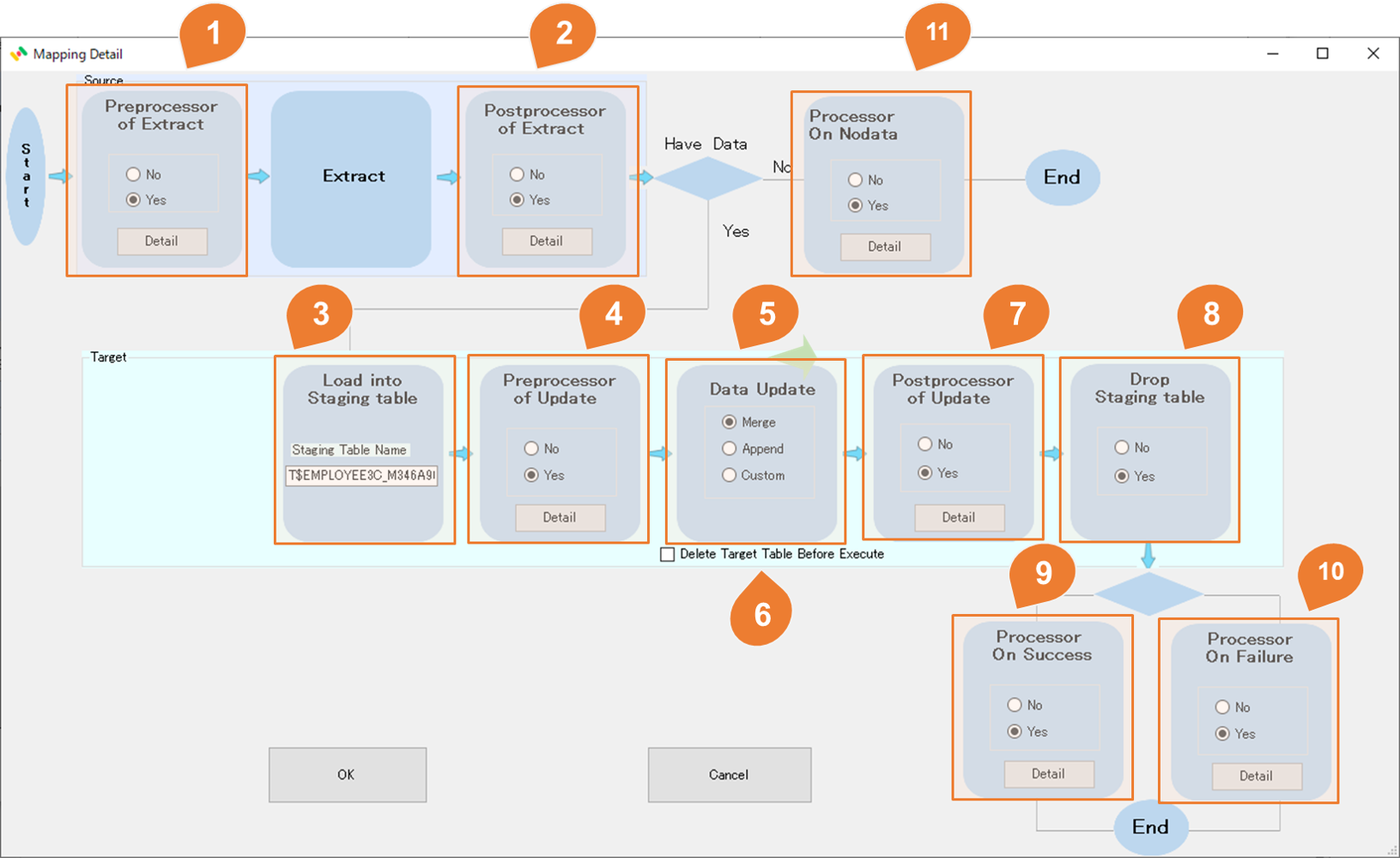
1. Pre-processing and Post-processing before and after Data extraction, updating.
2. Set up data processing, notification, etc. for success, failure or no target data during mapping.
configuration
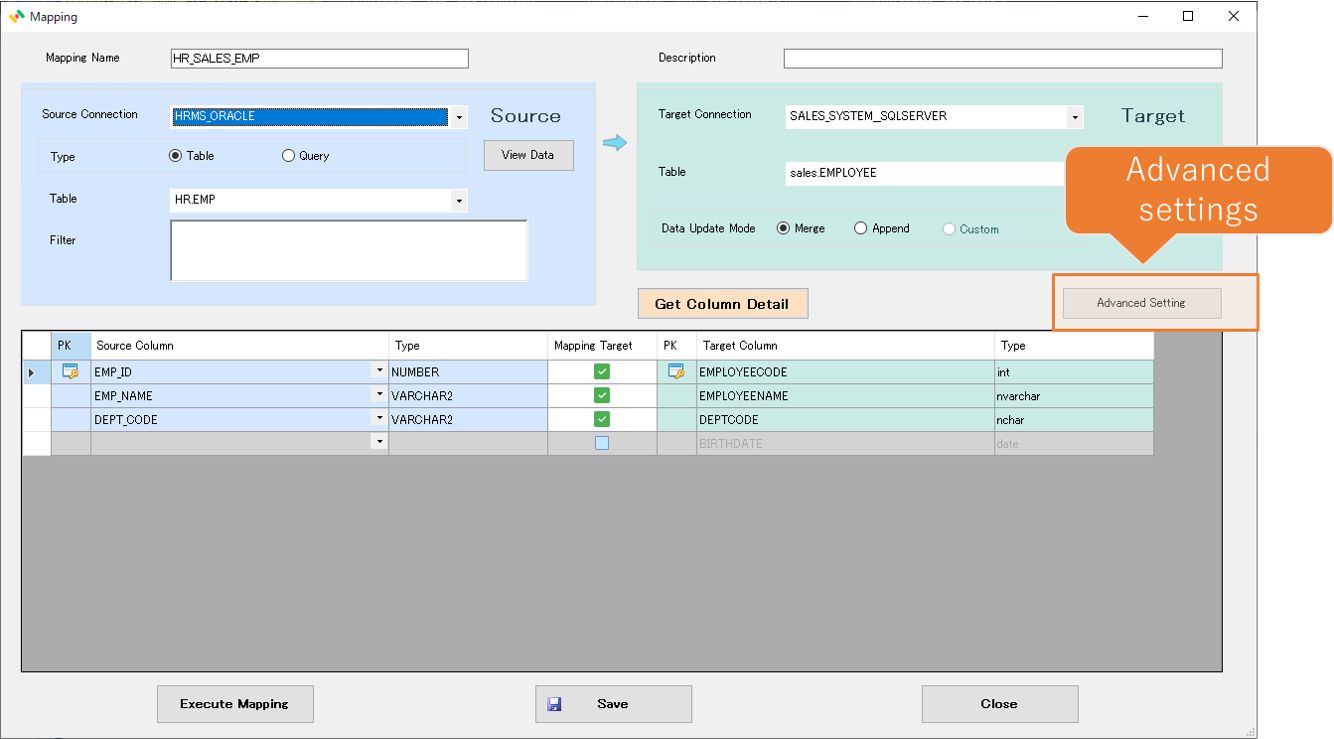
Advanced setting
| No | Item | Description |
|---|---|---|
| 1 | Preprocessor of Extract | You can execute SQL before data extraction.If you want to set it, choose Yes and click the Detail button to set the details. |
| 2 | Postprocessor of Extract | You can execute SQL after data extraction.If you want to set it, choose Yes and click the Detail button to set the details. |
| 3 | Staging table name | Before updating the data, SDI once loads the target data into the Staging table. The staging table name is auto-generated by the system and can be configured. Please enter the table name directly if you want to change it. If you want to use a table with a different schema than the target table, enter it in the following format. schema name.table name e.g : SCOTT.EMPTEMP |
| 4 | Preprocessor of update | You can execute SQL before data update.If you want to set it, choose Yes and click the Detail button to set the details. |
| 5 | Data Update Mode | Select how to update the target table.Merge - Merge the data into the target table using the primary key of the target table as a search condition.If the result is true, then updates the row with the corresponding data from the source table. In case the result is false for any rows, then inserts the corresponding row from the source table into the target table. If the target has no primary key, configure matching columns in Merge Details Append - Insert the data into the target table. Custom - Write a SQL statement for updating data. click the Detail button to set the SQL. |
| 6 | Delete Target Table Before Execute | Whether to delete the data in the target table before updating the data. |
| 7 | Postprocessor of update | You can execute SQL after data extraction.If you want to set it, choose Yes and click the Detail button to set the details. |
| 8 | Drop Staging table | Choose whether to drop a staging table created by this operation. Pre-existing tables are not dropped. PRIVATE cleanup is automatic; see Staging table details. |
| 9 | Processor on Success | You can define the treatment when the mapping process is successfully done. The treatment includes execute SQL, send an email, and if the source is a file, move, delete, backup, source file. |
| 10 | Processor on Failure | You can define the treatment when the mapping process is failed. The treatment includes execute SQL, send an email, and if the source is a file, move, delete, backup, source file. |
| 11 | Processor on Nodata | You can define the treatment when no extraction data exists. The treatment includes execute SQL, send an email, and if the source is a file, move, delete, backup, source file. |
Pre-processing, post-processing, data update content setting
| Target treatments |
|---|
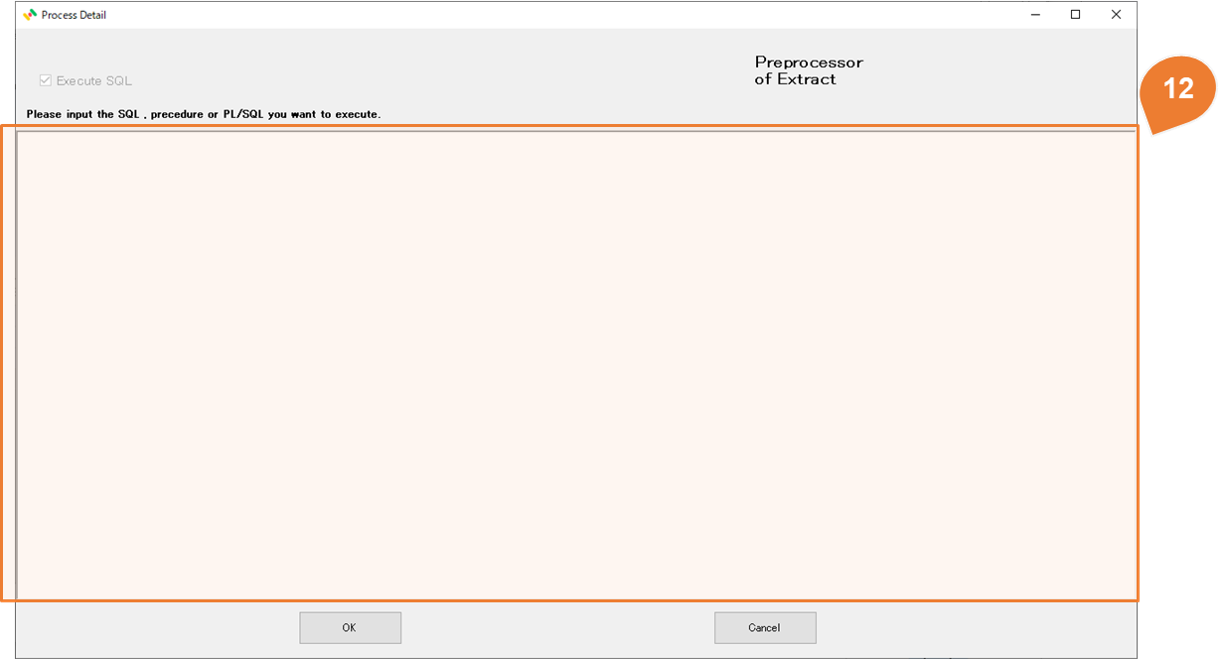
 Preprocessor of Extract  Postprocessor of Extract  Preprocessor of update  Data update(Custom)、  Postprocessor of update |
Setting form
| No | Item | Description |
|---|---|---|
| 12 | SQL | Enter the SQL to execute |
Treatment after mapping process (On Success , On Failure and On Nodata)
| Target treatments |
|---|
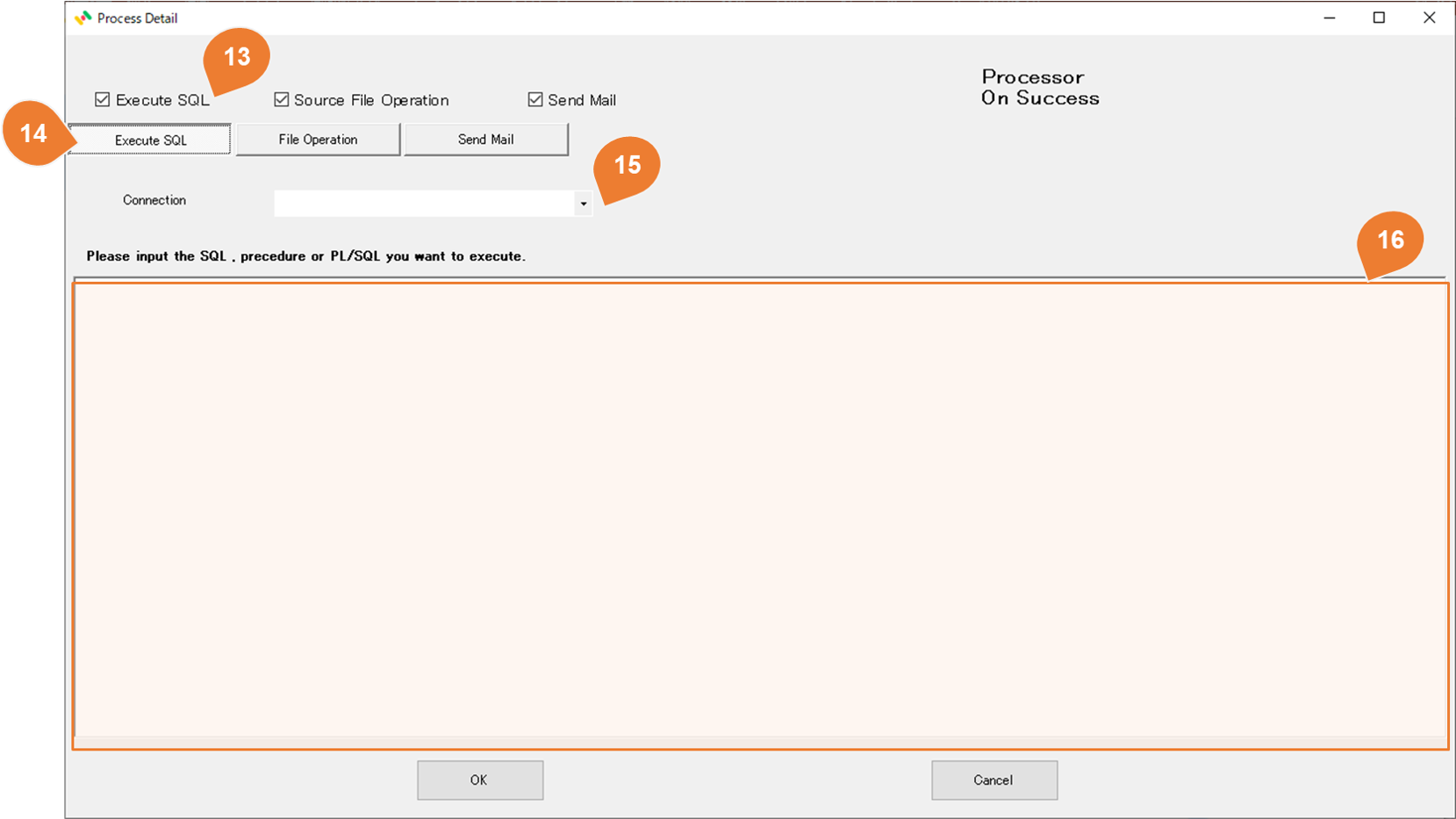
 Processor on Success  Processor on Failure  Processor on Nodata |
SQL execution configuraion
| No | Item | Description |
|---|---|---|
| 13 | Execute SQL checkbox | If you would like to Execute SQL, select the Execute SQL checkbox. If the Execute SQL checkbox is checked, the Execute SQL tab appears. |
| 14 | Execute SQL Tab | |
| 15 | Connection | Select the target database |
| 16 | SQL | Enter the SQL to execute |
Source File Operation configuraion
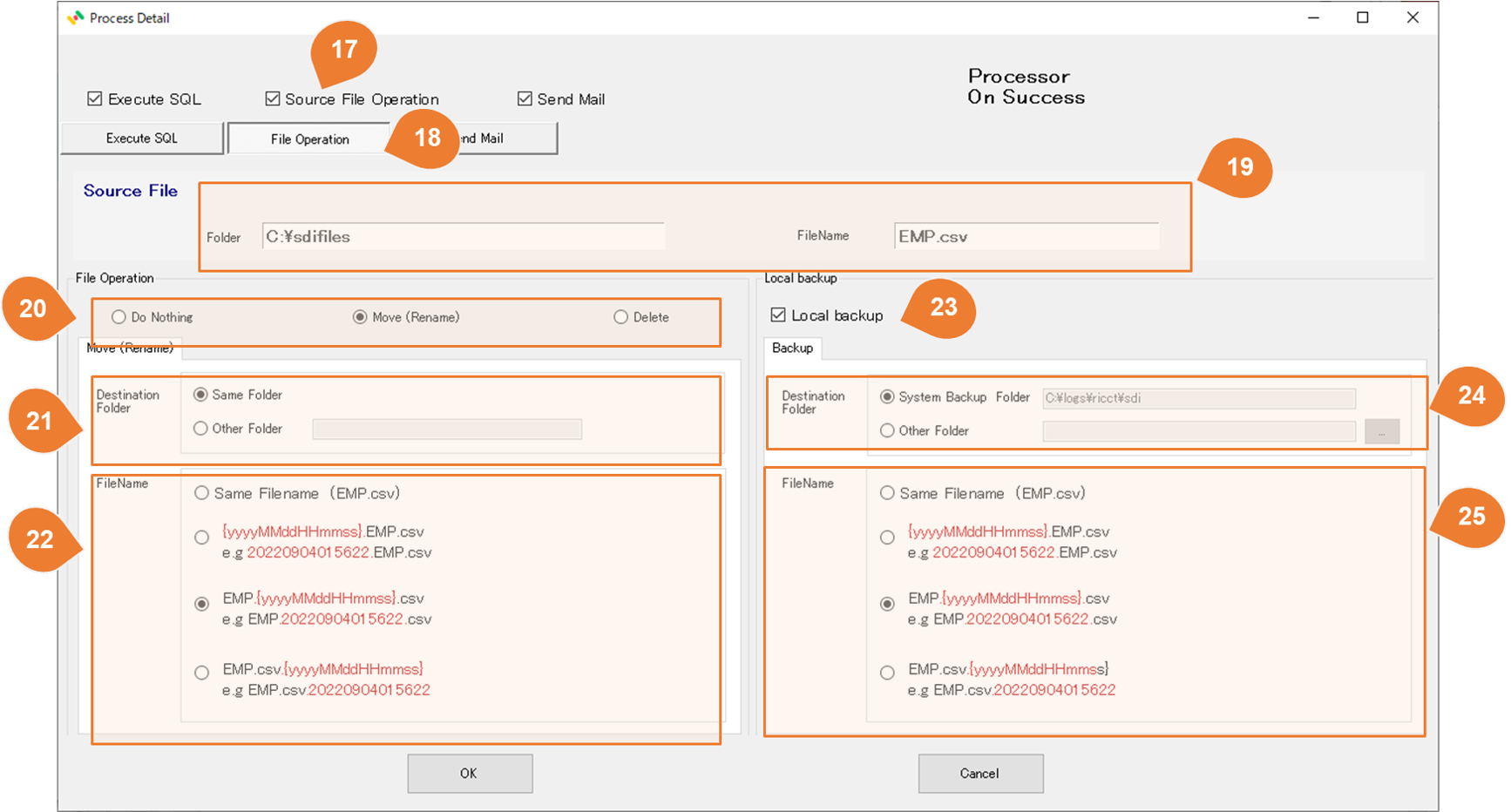
If the source is a file like CSV or Execl, you can delete or rename the source file when the import is complete.If you need to set it up, refer to the following manual.
* If the source is RDB, the checkbox will not be visible.
| No | Item | Description |
|---|---|---|
| 17 | Source File Operation checkbox | Check this checkbox if you want to remove or rename the source file when the mapping process is finished. |
| 18 | File Operation Tab | |
| 19 | Source File | Source file information is displayed. |
| 20 | File Operation | Do nothing - Not to operate on the source file.Move (Rename) - The source file will be moved or renamed when the mapping process is finished.Delete - The source file will be deleted when the mapping process is finished. |
| 21 | Destination Folder | Same Folder - Rename the source file in the same folder. Other Folder - Move and rename the source file to a different folder. |
| 22 | FileName | Same Filename - Keep the same filename. {yyyyMMddHHmmss}+File fullname - Put the current time ahead of the file full name. Filename+{yyyyMMddHHmmss}+ file extension - Insert the current time between the filename and the extension.File full name +{yyyyMMddHHmmss} - Add the current time to the back of the file full name. |
| 23 | Local Backup | Check this checkbox if you want to make a backup of the source file when the mapping process is finished. |
| 24 | Destination Folder | System Backup Folder - Use system setting folder. Other Folder - Set any folder. |
| 25 | FileName | Same Filename - Keep the same filename. {yyyyMMddHHmmss}+File fullname - Put the current time ahead of the file full name. Filename+{yyyyMMddHHmmss}+ file extension - Insert the current time between the filename and the extension.File full name +{yyyyMMddHHmmss} - Add the current time to the back of the file full name. |
Email notification configuration
| No | Item | Description |
|---|---|---|
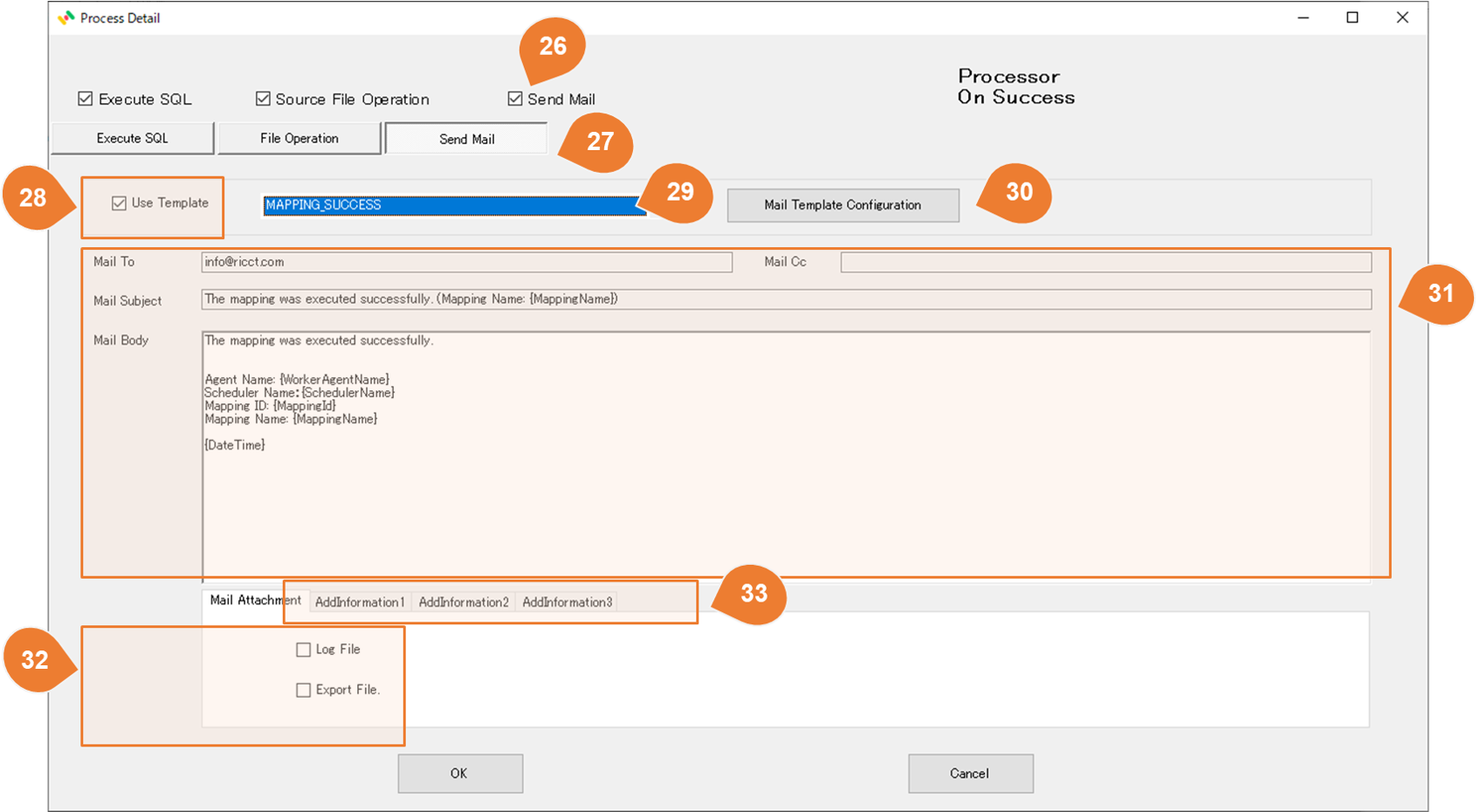
| 26 | Send Mail checkbox | Check this checkbox if you would like to send an email notification when the mapping process is complete. |
| 27 | Send Mail tab | |
| 28 | Use Template checkbox | Check this checkbox if you would like to use a predefined mail template. If unchecked, set the email content on this screen. |
| 29 | Template selection | Select the mail template while the Use Template checkbox is checked. |
| 30 | Mail Template configuration | Open Mail Template configuraion form. |
| 31 | Mail information | Set the message to, CC, subject of the e-mail, body of the e-mail, and so on. * When using an email template, it will be Read only. * For details on how to set the email title and body, please refer to the following document. How to write an email template |
| 32 | Mail attachments | It is possible to attach the following files when sending an email. Check the required files.Log File - Detailed LOG file for mapping execution. Export File - -If the target is a CSV or Excel file, you can attach the output file to an email. |
| 33 | AddInformation | You can set up to three additional information in the email title and body. The value {AddInformation1} 、{AddInformation2}、{AddInformation3} in the title and body of the email template will be replaced by the value entered here. |
Staging table details
For an RDB target, open Mapping Advanced Settings, then Detail under Load Into Staging Table. A staging table holds extracted data before the target is updated.

| No | Item | Description |
|---|---|---|
| 1 | Table type | Oracle offers Regular table, Temporary table (PRIVATE), and Temporary table (GLOBAL). |
| 2 | Explanation | Describes the scope and restrictions of the selected type. |
| 3 | Execute SQL Prior to Data Loading | Configure SQL before loading. Use this stage or update pre/post processing when the SQL must access a temporary table in its original connection. |
Choosing a table type
| Destination | Choices | Usage |
|---|---|---|
| Oracle, direct connection | Regular / PRIVATE / GLOBAL | Regular tables persist. PRIVATE definitions and data belong to this execution. GLOBAL definitions are shared, with data isolated to each connection. |
| SQL Server, PostgreSQL, MySQL, direct connection | Regular / Temporary | Temporary tables are used within the creating connection. Oracle’s PRIVATE/GLOBAL choices are not shown. |
| BigQuery, Snowflake | Regular / Temporary on supported connections | Uses the database product’s temporary tables. Available choices depend on the connection type. |
| Other databases or connection types | Available settings only | Temporary creation is not offered for every DB2 or arbitrary ODBC connection. |

The non-Oracle example uses the same numbers: 1 table type, 2 explanation, 3 pre-load SQL. Do not depend on temporary data surviving across connections or being accessible to a separate mapping. Specify PostgreSQL temporary table names without a schema.
Oracle PRIVATE
Requires Oracle 18c or later. SDI uses ON COMMIT PRESERVE DEFINITION, so a commit during execution does not remove the definition. Loading and target updates use the same connection. SDI removes the table when execution ends, including cleanup before a pooled connection is returned for reuse.
PRIVATE does not support mapped CLOB, NCLOB, or BLOB columns. Choose GLOBAL or a regular table when these columns must be written. Unmapped LOB columns on the target do not prevent PRIVATE use.
Physical names use Oracle’s private-table prefix, normally ORA$PTT_, without a schema. SDI uses the database prefix when it can read it. If a custom prefix is configured but unavailable to the connection, specify a complete ORA$... name that complies with the database rule. Keep the physical name within 128 bytes.
PRIVATE cannot be retained across executions. The data-retention checkbox is hidden. The parent Drop Staging Table setting stays visible but disabled and is treated as automatic cleanup. Do not access the table from a later connection or a Processor on Success action.
Oracle GLOBAL
SDI creates the table with ON COMMIT PRESERVE ROWS. The definition is shared, but loaded data belongs to its database session. For a newly created table that is not retained, SDI commits or rolls back the target update, clears the stage in the original loading session, closes that connection, then drops the definition.
Consequently, stage rows are already cleared when Processor on Success runs. Put SQL that needs these rows in Postprocessor of update. If another session is using the same GLOBAL table, Oracle may reject DROP. SDI records a cleanup warning and does not terminate the other session. Avoid competing staging names in concurrent executions.
Regular tables and retention
For regular tables, leaving Keep existing data unchecked clears existing rows before loading. Checking it retains those rows while loading. This is separate from the parent Drop Staging Table setting.
Even when dropping is enabled, SDI’s completion cleanup drops only a table created by that operation. It does not drop a table that already existed before execution.
ZIP password visibility in mail processing
In the mail processing details form, use Show beside the ZIP attachment password to show or hide its input. It is hidden initially, and closing the form restores masking.
When Studio authentication is enabled, each reveal requires the Studio authentication password. Canceling the confirmation keeps the ZIP password hidden.