System Settings
Use System Settings to configure the configuration folder, execution logs, sensitive data encryption, and the local Worker agent. Open Preferences → System Setting.
Settings form
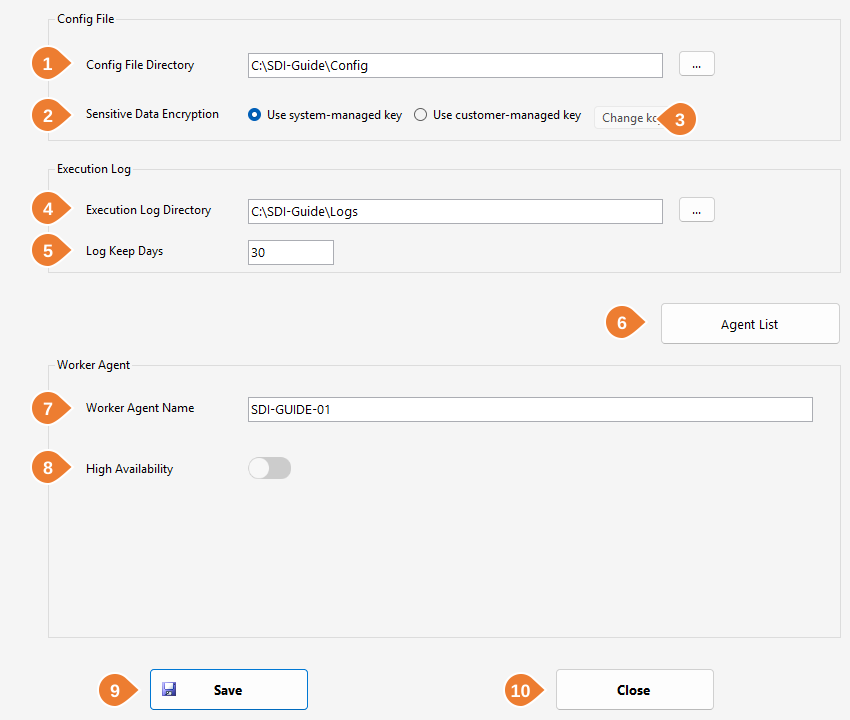
The image uses sample settings. Primary/Secondary and Failover Threshold appear when High Availability is enabled.
| No | Item | Description |
|---|---|---|
| 1 | Configuration file folder | Stores connections, mappings, and schedules. Computers sharing a configuration must access the same shared folder. |
| 2 | Sensitive Data Encryption | Select a system-managed or customer-managed key as described below. |
| 3 | Change key | Opens the key change dialog when customer-managed mode is selected. |
| 4 | Execution log folder | Select the execution log location. |
| 5 | Log keep days | Specify how many days to retain logs. |
| 6 | Agent List | Review registered agents and remove obsolete registrations. |
| 7 | Worker Agent Name | Set the display name of the agent on this computer. |
| 8 | High Availability | Switch between a single agent and a Primary/Secondary configuration. When enabled, select the role and the inactivity threshold in minutes for failover. |
| 9 | Save | Save changes. Follow any restart instructions displayed. |
| 10 | Close | Close the settings form. |
Sensitive data encryption
| Mode | Use | Operational requirements |
|---|---|---|
| System-managed key | A configuration used on one computer | The key is computer-specific. Copying the configuration folder to another computer is insufficient. |
| Customer-managed key | Multiple computers or clusters | Register the same key on every computer using the shared configuration. |
A customer-managed key must contain 16–128 characters and is case-sensitive. It cannot be viewed later, so copy it when entering or generating it and retain it using your organization's key storage process.
The mode is determined from the identity information (ClientId) in the selected folder's shared SdiSystem.config. Each computer stores its key locally in SdiWorkerBasic.config, protected by Windows DPAPI. Use Studio to change modes rather than editing these files manually.
Set or change a customer-managed key
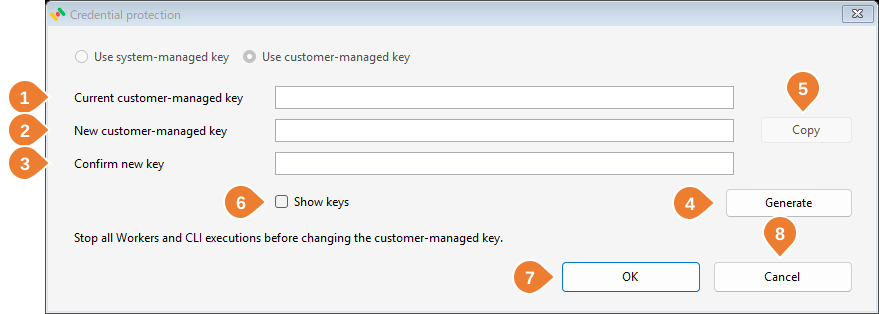
This image shows rotation of an existing customer-managed key. Initial setup does not require the current key. Re-registration does not display new-key confirmation or generation.
| No | Item | Description |
|---|---|---|
| 1 | Current customer-managed key | Enter the current key when changing it. |
| 2 | New customer-managed key | Enter the new key. |
| 3 | Confirm new key | Enter the same new key again. |
| 4 | Generate | Generate a key and fill the new-key and confirmation fields. |
| 5 | Copy | Copy the new key. |
| 6 | Show keys | Show or hide key values in this dialog. |
| 7 | OK | Validate the input and close the dialog. Also save the System Settings form. |
| 8 | Cancel | Close the key dialog. |
- Stop Workers and CLI executions on all computers and wait for active tasks to finish.
- Select customer-managed mode in System Settings, or select Change key to rotate an existing key.
- Enter the required keys and retain the new key.
- Select OK to validate, then Save in System Settings.
- On other computers, register the same key. Verify connections on every computer before restarting Workers or CLI executions.
Changing the configuration folder
The mode selection updates to match the selected folder. A new empty folder is displayed as system-managed.
Studio validates the selected folder's key and requests a customer-managed key if needed. Failed validation or cancellation restores the previous selection. Selecting and validating a folder does not rewrite its existing shared settings; use Save to apply the change.
Initialization, recovery, and backup
Use Studio for initial configuration creation. Worker and CLI do not initialize settings.
If a management key or ClientId cannot be read, use the recovery dialog to re-register the customer-managed key, select another configuration folder, or contact support. Preserve the existing key and configuration files during recovery.
Back up the configuration folder and each computer's local settings, and retain the customer-managed key separately. Local settings are protected for their computer, so copying them does not replace key registration on a different computer.
If settings changed concurrently, restart Studio or reload settings, then repeat the operation using the latest state.