WEB Service/API/OData configuration
Overview
SDI can retrieve and update data by integrating with external Web Services and Web APIs.
The supported communication protocols are REST, SOAP (HTTP), and OData (OData v2 / v4).
HTTP Methods
- GET / POST (Availability depends on the specifications of the destination API)
OData
- Supports data retrieval using query options such as
$filteragainst OData endpoints.
(Compatibility and behavior depend on the OData implementation of the connected system)
Supported Authentication Methods
SDI supports the following authentication methods:
- Anonymous Authentication
- Basic Authentication
- JSON Web Token (JWT) Authentication
- API Key Authentication
Digest Authentication(Removed as of Ver. 26.1.2)
Configuration
Web Service / API / OData
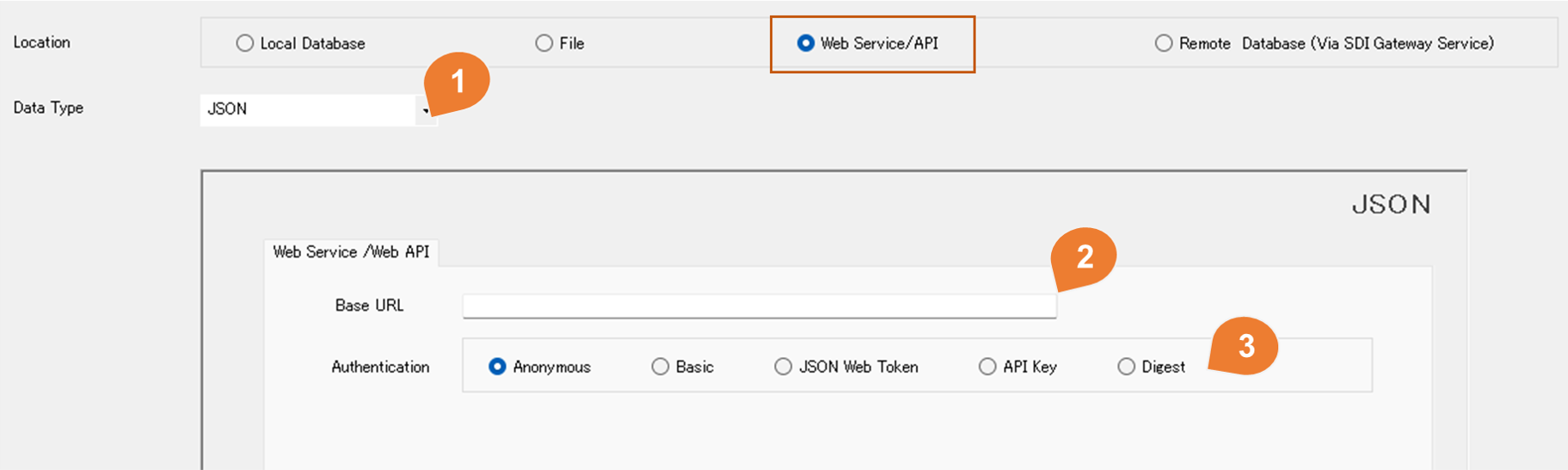
Select 'Web Service / API' as the location.
| No | Item | Description |
|---|---|---|
| 1 | Data Type | Select CSV, Excel, JSON, XML, or OData. |
| 2 | Base URL | Specify the base URL for all relative URLs. |
| 3 | Authentication | Select the authentication method. |
Basic Authentication
| No | Item | Description |
|---|---|---|
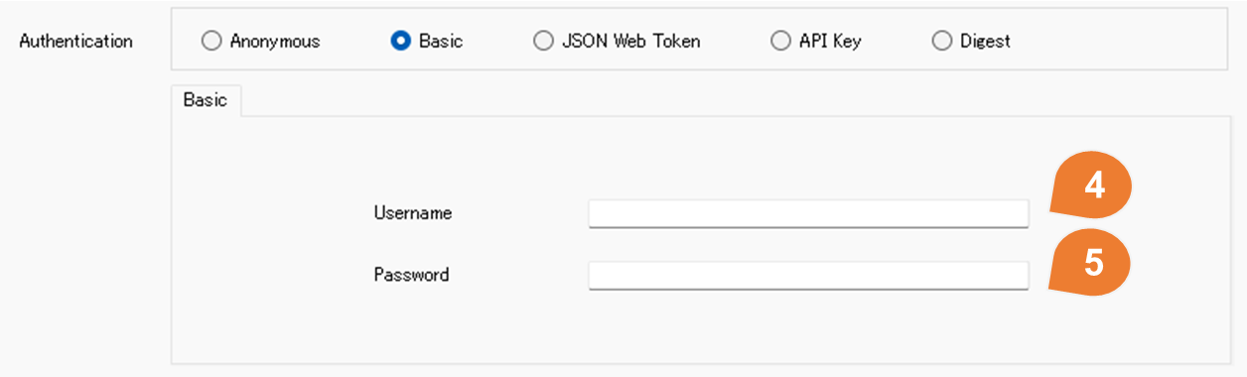
| 4 | Username (Basic Authentication) |
Enter the username if Basic Authentication is selected. |
| 5 | Password (Basic Authentication) |
Enter the password if Basic Authentication is selected. |
JSON Web Token (JWT) Authentication
| No | Item | Description |
|---|---|---|
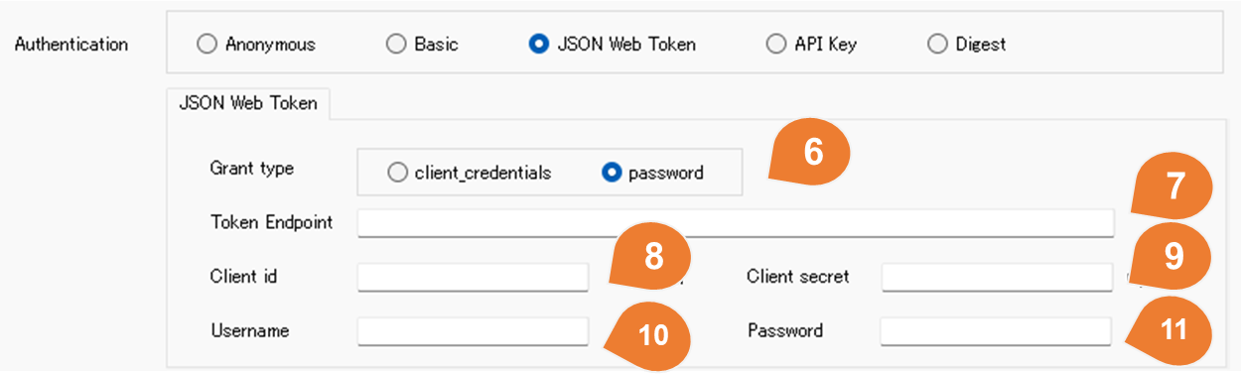
| 6 | Grant type | A parameter specifying the method for obtaining an access token. |
| 7 | Scope | Specify the scope required by the destination API as a string. If the API does not require a scope, this field may be left blank (depending on the API specifications). |
| 8 | Token Endpoint | The API endpoint on the server for obtaining authentication tokens. |
| 9 | Client ID | An ID that uniquely identifies your application registered in the system. *If "Password" is selected as the Grant type, this may be optional depending on the system. |
| 10 | Client Secret | A secret key used to authenticate the client (your application) along with the Client ID. *If "Password" is selected as the Grant type, this may be optional depending on the system. |
| 11 | Username | An identifier to specify the user utilizing the system. |
| 12 | Password | A secret credential used for user authentication. It is used together with the Username, and upon providing the correct information, the system issues a JWT and establishes an authenticated session. |
API Key Authentication
| No | Item | Description |
|---|---|---|
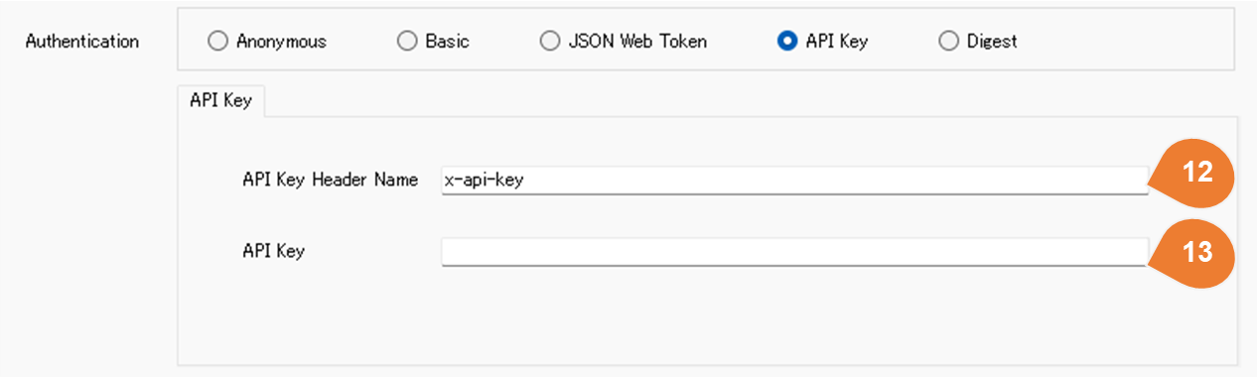
| 21 | API Key Header Name | The name that specifies where the API Key is placed in the API request header. For example, x-api-key is commonly used as the API Key header name, but some systems may require a custom name. |
| 22 | API Key | Enter the API Key value. |
Digest Authentication (Removed as of Ver. 26.1.2)
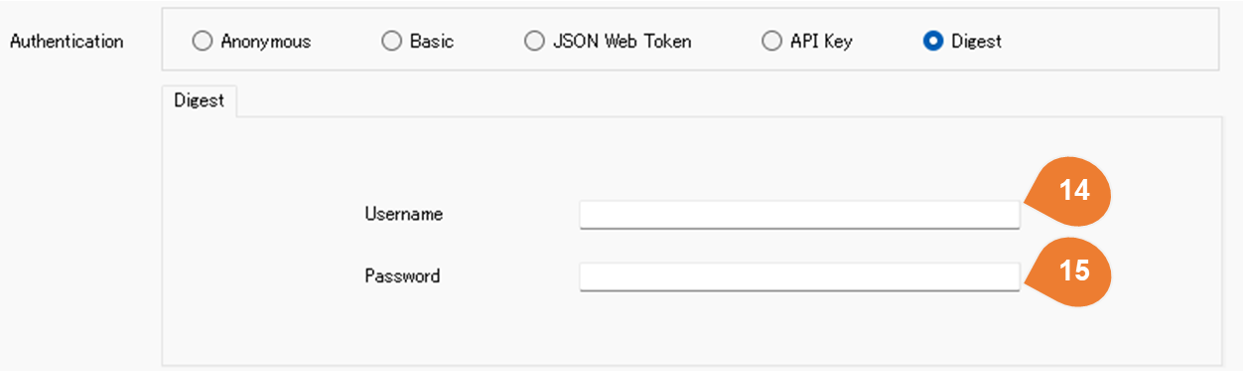
| No | Item | Description |
|---|---|---|
| 23 | Username (Digest) |
Enter the username if Digest Authentication is selected. |
| 24 | Password (Digest) |
Enter the password if Digest Authentication is selected. |
Headers, cookies, and token lifetime
Custom headers in Web Request Details are sent for GET, POST, and subsequent pages. Authentication configured on the connection takes precedence over manually specified authentication headers. With Anonymous authentication, a manually configured Authorization header can be used. Invalid headers cause an error.
Cookies are retained across pages of the same API execution. They are not shared with another execution or connection.
OAuth tokens follow the response's expires_in. If a JWT exp is also available, the earlier expiration is used, with renewal before expiry. If neither expiration can be determined, the token is fetched again instead of being cached for a fixed duration.
For date-based Web API extraction, see incremental API retrieval.